

Polar Ice Maker 50kg Output - GK032-A
Sale price
$2,177.90Regular price $2,419.89Save $241.99
Nothing in here yet. Start with our best sellers, or ask our AI assistant what suits your kitchen.


Fridges
Freezers
Ice Makers
Cooking
Food Display
Food Prep
Drinks & Coffee
Dishwashers
Stainless Steel

A good deep fryer earns its keep in a cafe, pub or takeaway, but the right one depends on how much you fry, the space you have, and the power or gas on site. Here's how to choose between gas and electric, benchtop and freestanding, one tank or two, and what size to get. The full range is in our commercial deep fryers collection.
Picture your busiest hour. A cafe frying a few serves of chips needs something very different from a fish and chip shop with a queue out the door.
Every basket of frozen chips drops the oil temperature. A fryer with more oil and more power recovers faster, while one that's too small falls behind and turns out greasy batches when you're busiest.
Benchtop deep fryers sit on a counter, are usually electric and plug in. They're easy to move and clean, and suit kitchens with lighter frying. The Roband Single Pan Fryer 5L (F15), for example, has a 5 litre capacity, an easily removable tank and a pan cover, and is rated at 10 amps.
Freestanding deep fryers stand on the floor, hold much more oil, and come in gas and electric models. They need floor space and the right gas or power connection, and usually have a drain valve so you can empty the oil without lifting the tank.
The better choice usually comes down to what your site has and how hard the fryer will work.
If you go gas, check whether your site runs on natural gas or LPG, and order the model that matches. Many gas fryers are listed as separate natural gas and LPG models, or with a gas type option to choose. The Gasmax Superfast tube fryer, for example, comes as a natural gas model (RC400E) and an LPG model (RC400ELPG). Both hold 22 litres of oil and come with two baskets.
A single tank holds one batch of oil at one temperature, though some take two baskets so you can cook two smaller batches side by side.
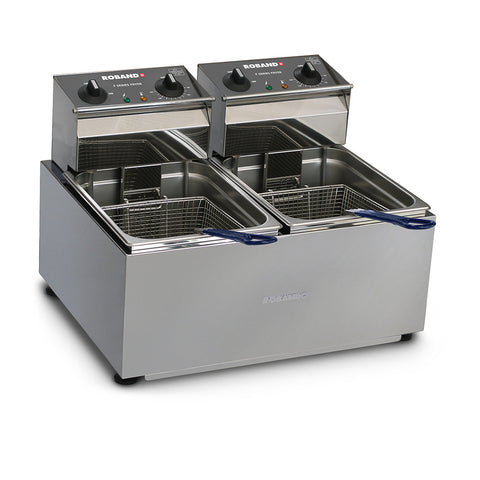
A twin tank fryer gives you two separate pots of oil. You can keep seafood apart from chips so flavours don't carry over, cook at two different temperatures, or switch one side off when it's quiet. The Apuro Twin Tank Electric Fryer with Timer 2x8L (CU621-A) works this way: each tank is controlled separately, it has digital timers and front drain taps, and each tank has its own 15 amp power lead, so you'll need two 15 amp outlets where it sits.
Some listings give the oil capacity and some give the tank size, and they aren't the same thing. On the Gasmax tube fryer, the oil capacity is 22 litres and the tank capacity is 26 litres. Compare like with like, and remember a bigger fryer takes more oil to fill and replace. Also check:
Before you buy, check the power, the gas type and the size suit your site: 10A, 15A or three-phase power, natural gas or LPG, and the width, depth and height. Our product pages show these where we have them, and our AI assistant can help you check any time.
Our Warranty & Service page asks that electrical and gas equipment is installed by a licensed technician, so talk to your gas fitter or electrician before you order, and ask about ventilation for frying too. New products we sell (excluding accessories and parts) include a minimum 12-month manufacturer's warranty unless otherwise stated. Warranties don't cover a lack of maintenance, so follow the care steps in the manual.
Freestanding fryers are heavy. Our standard delivery is kerbside to a commercial address, and any item over 22kg arrives on a pallet. Standard delivery doesn't include moving it through doors or into the building, so plan how the fryer will get to its spot.
A small benchtop fryer usually costs the least up front, and it's often all a cafe needs. Just don't buy too small for your busy times. If you've seen the same fryer for less from an authorised Australian retailer, with freight to your door included, send it to us and we'll beat it. Terms apply, and they're on The CEO Promise page. To spread the cost, we also accept SilverChef and Zip.
It depends on your site's gas supply. Order the model that matches it, check the gas type in the product title or specs, and have a licensed gas fitter connect it.
Match it to your busiest hour: 3 to 5 litres for light frying, 8 to 11 litres or a twin tank for busy cafes and pubs, and a freestanding fryer for most takeaways.
Some will. The Roband 5L fryer is rated at 10 amps, but many larger benchtop fryers need a 15 amp outlet, and twin tank models can have a lead for each tank. Check the amps on the product page and have your electrician confirm your outlets.
Ready to compare? See every benchtop and freestanding model in our commercial deep fryers range.
Shop the range

Flat or ribbed plates, single or double, cast iron or aluminium, 10 amp or 15 amp: how to choose a commercial sandwich press that keeps up...

Work out how many kilograms of ice you need a day, then choose between self-contained and modular, air and water cooling, and the right ice for...

What happens after you order: when it's dispatched, when tracking arrives, typical delivery times, and what to check when it lands.






Leave a comment