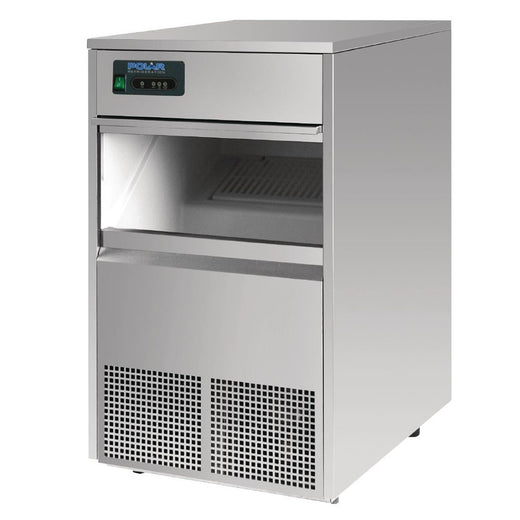
Polar Ice Maker 50kg Output - GK032-A
Sale price
$1,640.80Regular price $2,419.89Save $779.09
$1,446.89$1,591.58 with BLACK2026
Nothing in here yet. Start with our best sellers, or ask our AI assistant what suits your kitchen.
$1,446.89$1,591.58 with BLACK2026

from $173.15$190.46 with BLACK2026

$1,350.42$1,485.46 with BLACK2026

$672.12$739.33 with BLACK2026

Fridges
Freezers
Ice Makers
Cooking
Food Display
Food Prep
Drinks & Coffee
Dishwashers
Stainless Steel
Kitchenware
Furniture
Laundry
This range covers commercial gas and electric griddles for cooking burgers, eggs and pancakes on a flat plate in cafes, takeaways and restaurant kitchens. Countertop electric griddles from Apuro and Roband suit smaller benches, while Goldstein, Mercury, Thor and Gasmax gas griddles come in natural gas and LPG models, alongside Goldstein gas teppanyaki plates. For heavy-duty lines, Waldorf Bold griddles come as bench models or on leg stands and cabinet bases, alongside griddle oven ranges.
 20% off
 Waldorf
600(W) x 805(D) x 972(H)mm
$8,154.21$8,969.63 with BLACK2026
or $117.37/wk with SilverChef
 20% off
Waldorf
600(W) x 805(D) x 1130(H)mm
$8,154.21$8,969.63 with BLACK2026
or $117.37/wk with SilverChef
 20% off
Waldorf
600(W) x 805(D) x 372(H)mm
$6,584.36$7,242.80 with BLACK2026
or $94.77/wk with SilverChef
 20% off
Waldorf
600(W) x 805(D) x 530(H)mm
$6,584.36$7,242.80 with BLACK2026
or $94.77/wk with SilverChef
 20% off
 Cobra
305(W) x 800(D) x 485(H)mm
$1,989.66$2,188.63 with BLACK2026
or $28.64/wk with SilverChef
 20% off
Cobra
900(W) x 800(D) x 485(H)mm
$3,254.55$3,580.00 with BLACK2026
or $46.84/wk with SilverChef
 20% off
Cobra
900(W) x 800(D) x 485(H)mm
$3,254.55$3,580.00 with BLACK2026
or $46.84/wk with SilverChef
 20% off
Cobra
900(W) x 800(D) x 485(H)mm
$3,254.55$3,580.00 with BLACK2026
or $46.84/wk with SilverChef
 20% off
Cobra
600(W) x 800(D) x 485(H)mm
$2,438.96$2,682.86 with BLACK2026
or $35.10/wk with SilverChef
 20% off
Cobra
600(W) x 800(D) x 485(H)mm
$2,438.96$2,682.86 with BLACK2026
or $35.10/wk with SilverChef
 20% off
Cobra
900(W) x 800(D) x 1085(H)mm
$4,676.95$5,144.65 with BLACK2026
or $67.32/wk with SilverChef
 20% off
Cobra
600(W) x 800(D) x 1085(H)mm
$3,967.69$4,364.46 with BLACK2026
or $57.11/wk with SilverChef
 20% off
Cobra
900(W) x 800(D) x 1085(H)mm
$5,574.01$6,131.41 with BLACK2026
or $80.23/wk with SilverChef
 20% off
Cobra
900(W) x 800(D) x 1085(H)mm
$5,574.01$6,131.41 with BLACK2026
or $80.23/wk with SilverChef
 20% off
Cobra
900(W) x 800(D) x 1085(H)mm
$5,574.01$6,131.41 with BLACK2026
or $80.23/wk with SilverChef
 20% off
Cobra
600(W) x 800(D) x 1085(H)mm
$4,458.90$4,904.79 with BLACK2026
or $64.18/wk with SilverChef
 20% off
Cobra
600(W) x 800(D) x 1085(H)mm
$4,458.90$4,904.79 with BLACK2026
or $64.18/wk with SilverChef
 20% off
Cobra
900(W) x 800(D) x 1085(H)mm
$3,946.74$4,341.41 with BLACK2026
or $56.81/wk with SilverChef
 20% off
Cobra
900(W) x 800(D) x 1085(H)mm
$3,946.74$4,341.41 with BLACK2026
or $56.81/wk with SilverChef
 20% off
Cobra
900(W) x 800(D) x 1085(H)mm
$3,946.74$4,341.41 with BLACK2026
or $56.81/wk with SilverChef
 20% off
Cobra
600(W) x 800(D) x 1085(H)mm
$3,028.73$3,331.60 with BLACK2026
or $43.59/wk with SilverChef
 20% off
Cobra
600(W) x 800(D) x 1085(H)mm
$3,028.73$3,331.60 with BLACK2026
or $43.59/wk with SilverChef
 25% off
 Blue Seal
450(W) x 1085(D) x 1085(H)mm
$5,561.02$6,117.12 with BLACK2026
or $80.04/wk with SilverChef
 25% off
Blue Seal
450(W) x 1085(D) x 1085(H)mm
$5,379.86$5,917.85 with BLACK2026
or $77.43/wk with SilverChef
Page 9 of 14
Buying guide
Need a hand choosing?
Our AI assistant can answer questions on size, power and gas. Prefer a person? Email or call the team.
Ask our AI assistantA griddle is a thick, flat metal plate heated from below by gas burners or electric elements. Food cooks right on the plate, so it suits eggs, pancakes, burgers, steak, onions and vegetables. In Australia it is often called a hotplate or griddle plate. A chargrill is different: it cooks over open grates and leaves char lines.
Both are common. More than 150 of our griddles are gas and more than 90 are electric. A gas griddle runs on natural gas or LPG, so check which one the model is set up for, and have a licensed gas fitter connect it. An electric griddle needs no gas line. Check the power supply on the spec sheet before you buy: some larger electric models need three-phase power.
Our griddle plates run from 300 mm wide up to about 1,220 mm, and most are between 400 and 1,200 mm. Measure the space on your bench or cooking line first, then think about how much you cook at your busiest time. Plates of 300 to 400 mm fit a small bench, and plates of 900 mm and wider give room for several orders at once.
A flat plate is the all-rounder for eggs, pancakes and burgers. A ribbed plate leaves grill lines on steak and vegetables, and a half-ribbed plate gives you both on one griddle: 14 of ours have a ribbed or half-ribbed plate. About 40 of our griddles have a chrome plate. Makers describe chrome as easier to clean, and some as cooler to work beside.
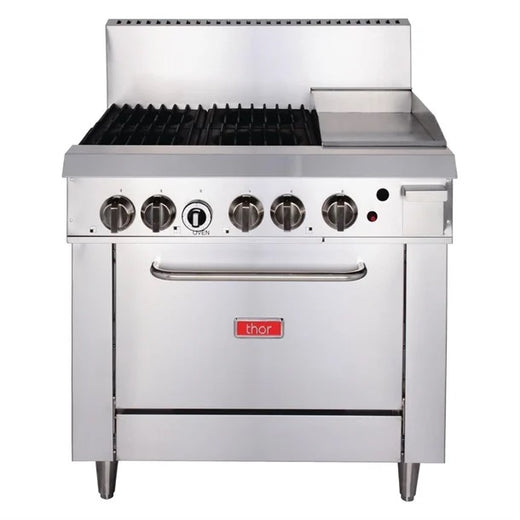
Benchtop griddles sit on a bench or a stand, and more than 80 of ours come on legs, a stand or a cabinet base. To save space on the line, choose a griddle with an oven underneath from our oven ranges, or a griddle toaster, which has a grill above the plate for melting and browning.
Usually, yes. In Australia, exhaust over commercial cooking is covered by the National Construction Code and AS 1668.2, and what you need depends on the equipment and the building. Check with your council and installer before you buy. See our exhaust canopies.
Need a hand choosing?
Our AI assistant can answer questions on size, power and gas. Prefer a person? Email or call the team.
Ask our AI assistantPick up where you left off